2026-10-20 15:53:00
Yes, a cotton picker can sometimes continue working when cotton has light surface moisture, but harvesting wet cotton is generally not ideal. Excess moisture can affect picking efficiency, spindle cleanliness, cotton flow, plugging risk, and the condition of seed cotton after harvest.
The key issue is not simply whether cotton feels wet. Operators need to consider where the moisture is coming from, how much moisture is present, how the crop is behaving inside the picking units, and whether harvested cotton can still move and be stored safely.
Morning dew, recent rainfall, damp plant material, and wet soil can all affect a cotton picker differently. That is why the decision to harvest should be based on actual field conditions rather than a fixed clock time.
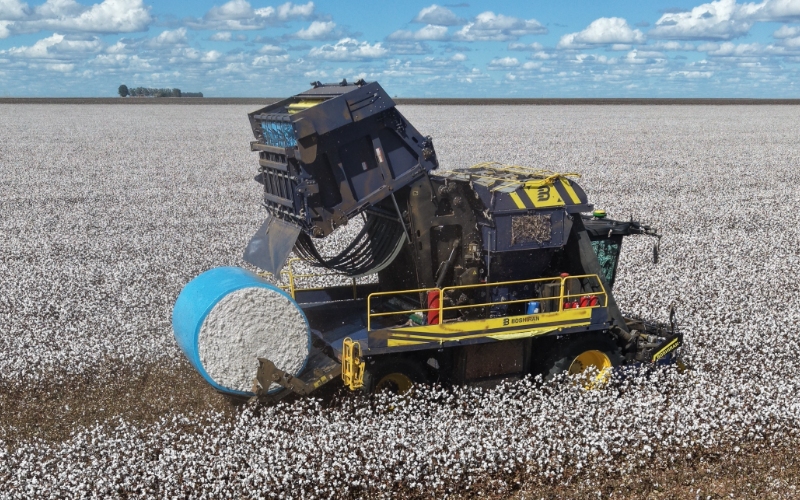
A spindle-type cotton picker depends on several systems working together:
spindles engage exposed seed cotton;
doffers remove cotton from the spindles;
moistener pads help keep spindles clean;
airflow moves harvested cotton through the machine;
a basket or baling system handles the collected cotton.
When the crop is excessively wet, each of these stages can become more difficult.
Moisture may cause cotton and plant residue to become heavier or more adhesive, increasing the chance of:
cotton remaining on the plant;
plant material sticking inside row units;
cotton wrapping around spindles;
plugging in ducts;
slower cotton movement;
contamination or storage problems.
This means wet conditions can reduce both cotton picker performance and overall harvest efficiency.
In most cases, operators should allow cotton to dry adequately after rainfall before resuming mechanical harvesting.
Rain affects more than the visible cotton lint.
It may also leave moisture on:
leaves;
stems;
boll surfaces;
field residue;
soil.
Even if the upper part of the plant appears dry, moisture may remain deeper in the canopy.
Harvesting too soon after rain can result in wet plant material entering the picker together with seed cotton.
This can make the harvesting process less stable and may increase buildup inside the row units and conveying system.
Before restarting after rain, operators should inspect several areas of the field instead of checking only plants along the field edge.
Morning dew is one of the most common reasons cotton harvesting is delayed at the beginning of the day.
Light dew does not always mean the crop is completely unsuitable for harvesting, but heavy dew can make both cotton and plant material damp.
The effect often varies within the same field.
For example:
exposed rows may dry first;
low areas may remain damp longer;
dense cotton canopies may hold moisture;
shaded field edges may dry more slowly.
Rather than starting simply because a certain time has passed, operators should examine the crop and perform a short field test.
If cotton begins wrapping, plugging increases, or harvesting quality becomes inconsistent, the crop may still be too wet.
Spindles need to interact efficiently with exposed cotton fibers.
When cotton and plant surfaces are excessively wet, plant residue and gum can accumulate more easily around the picking system.
Operators may notice:
dirty spindle surfaces;
more cotton wrapping;
reduced cotton removal;
uneven picking between rows.
However, wet conditions should not automatically be blamed for every spindle problem.
Similar symptoms can also result from:
worn spindles;
damaged doffers;
incorrect picker-bar adjustment;
poorly functioning moistener pads.
If performance deteriorates suddenly during a damp period, check both crop moisture and machine condition.
This is an important distinction.
A cotton picker uses a spindle moistening system, but that does not mean wet cotton is beneficial.
The moistening system applies controlled cleaning solution to the spindle area to help reduce plant gum and residue buildup.
This is very different from cotton plants being wet because of:
rainfall;
dew;
irrigation;
high humidity.
The moistening system is designed to control spindle cleanliness.
Field moisture, by contrast, affects the entire crop and can make cotton and plant material more difficult to handle.
Operators should therefore not reduce or disable the moistening system simply because the crop is damp unless the machine manufacturer specifically recommends an adjustment.
Doffers help remove cotton from the rotating spindles.
When crop material becomes sticky or cotton wraps around spindles, cotton release can become less consistent.
Possible symptoms include:
cotton remaining around the spindle;
cotton building up near doffers;
irregular transfer into the conveying system.
Before replacing doffers, check whether the problem only occurs during damp conditions.
If performance returns to normal as the crop dries, moisture may be an important contributing factor.
If the problem continues under dry conditions, inspect:
doffer wear;
spindle condition;
clearances;
picker-bar position;
moistener-pad condition.
After cotton is removed from the spindle, airflow carries it through ducts toward the basket or baling system.
Dry cotton is relatively light and moves readily through the air system.
Wet cotton is heavier and can be more difficult to convey.
Moist plant residue may also stick to duct surfaces.
As a result, operators may experience:
slower cotton flow;
cotton buildup;
duct plugging;
row-unit choking;
more frequent stops for cleaning.
This is especially important in high-yielding fields, where the conveying system is already handling a large amount of cotton.
If plugging increases during damp conditions, reducing ground speed may help temporarily, but the better solution may be to wait until the crop dries sufficiently.
It can.
Moisture can contribute to harvest loss in several ways.
If the picking system cannot engage and release damp cotton consistently, more seed cotton may remain in open bolls.
Poor cotton flow or unstable row-unit operation can contribute to cotton falling during harvesting.
Frequent stops, reversals, or cleaning operations can interrupt normal harvesting and make operation less consistent.
However, moisture is only one possible cause of cotton loss.
If losses remain high when the crop is dry, operators should also inspect:
spindle wear;
doffer condition;
row alignment;
ground speed;
picking-unit adjustment.
Ground speed often needs to be reduced when crop conditions become damp.
A slower forward speed gives the picking and conveying systems more time to handle material.
This may help reduce:
cotton buildup;
row-unit plugging;
unstable cotton flow.
But slowing down has limits.
If the cotton is simply too wet to harvest efficiently, reducing speed further may only lower field productivity without solving the underlying problem.
Operators should therefore consider moisture and ground speed together.
Our guide on how ground speed affects cotton picker efficiency and harvest loss explains this relationship in more detail.
The effects of moisture continue after cotton leaves the picker.
Seed cotton may remain in:
a picker basket;
a transport vehicle;
a field module;
a formed bale.
If cotton is stored with excessive moisture, the risk of quality problems can increase.
Possible concerns include:
heating;
discoloration;
microbial activity;
reduced storage stability.
This is one reason the decision to harvest wet cotton should consider not only whether the picker can physically collect the crop, but also what happens after collection.
The requirements of the gin, buyer, local storage system, and cotton-handling process should be considered before harvesting cotton under questionable moisture conditions.
Cotton plants are not the only concern after rainfall.
Wet soil can also affect harvesting.
A heavy cotton picker operating on soft ground may experience:
wheel slip;
rutting;
poor steering;
uneven row tracking;
soil compaction;
difficulty turning.
Poor machine stability can indirectly increase cotton loss if row units cannot remain aligned with the plants.
Operators should therefore inspect field trafficability as well as crop moisture before resuming harvest.
A crop may be dry enough to pick while the soil is still too wet to support the machine effectively.
There is no single visual sign that works in every field, but several symptoms can indicate that conditions are not suitable.
Examine cotton from different parts of the field.
Look for:
obvious surface dampness;
cotton that feels heavy or sticky;
moisture deeper inside open bolls;
damp leaves and stems.
Do not check only the driest plants.
If leaves, stems, and field residue are still visibly wet, additional plant material may stick inside the picker.
Operate the cotton picker for a limited distance and inspect:
cotton remaining on plants;
spindle cleanliness;
cotton wrapping;
row-unit plugging;
conveying ducts;
cotton entering the basket or baling system.
A short test can reveal problems before the machine is committed to full-scale harvesting.
Operators should consider stopping and allowing the crop to dry when several of the following problems appear:
| Field or Machine Symptom | Possible Moisture Effect |
|---|---|
| Cotton feels damp or sticky | Crop may not be sufficiently dry |
| Increased spindle wrapping | Wet crop residue may be building up |
| More cotton left on plants | Picking quality may be declining |
| Frequent row-unit plugging | Wet material may restrict cotton flow |
| Cotton buildup in ducts | Conveying becomes less efficient |
| Heavy plant residue inside picker | Damp leaves and stems may be sticking |
| Wheel slip or rutting | Soil may still be too wet |
| Cotton in basket/bale feels damp | Post-harvest handling risk may increase |
One symptom alone does not always mean harvesting must stop, but several occurring together are a strong reason to reassess conditions.
There is no universal waiting period.
Drying time depends on:
rainfall amount;
temperature;
sunlight;
wind;
humidity;
plant density;
field drainage.
Two fields receiving the same rain can become harvest-ready at very different times.
For this reason, a rule such as "wait a fixed number of hours" can be misleading.
The better approach is to evaluate the actual crop and field conditions before restarting.
Some operating adjustments may help when moisture conditions are only slightly challenging.
Operators may consider:
reducing ground speed;
checking spindle cleanliness more frequently;
monitoring moistener-system operation;
cleaning row units and ducts;
checking for early signs of plugging.
However, avoid making aggressive mechanical adjustments simply to force the machine to harvest unsuitable cotton.
Do not change spindle-to-doffer clearance, picker-bar settings, system pressures, or other model-specific adjustments outside the manufacturer's recommended range.
If normal settings cannot maintain acceptable harvesting performance, waiting for better field conditions may be more effective than continuing to adjust the machine.
One useful diagnostic question is:
Did the problem begin only when crop moisture increased?
If yes, moisture may be a major factor.
If the same problem occurs in both dry and wet conditions, the machine itself may require inspection.
For example:
Cotton left on plants in dry conditions
Check spindles, row alignment, ground speed, and crop maturity.
Spindle wrapping in dry conditions
Check doffers, moistener pads, spindle condition, and picker-bar adjustment.
Frequent plugging in dry conditions
Check airflow, ducts, crop load, and conveying components.
This helps avoid replacing parts when the actual problem is environmental.
For buyers operating in regions where harvest conditions can change quickly, several machine characteristics deserve attention.
These include:
reliable spindle-cleaning system;
effective cotton conveying airflow;
accessible row units for inspection and cleaning;
suitable ground clearance;
stable drivetrain;
practical maintenance access;
availability of wear parts and service support.
However, no cotton picker eliminates the influence of moisture entirely.
Even a high-capacity machine performs best when crop and field conditions are suitable.
Machine capability and harvest timing need to work together.
So, can you pick cotton when it is wet?
A cotton picker may sometimes operate under light moisture conditions, but harvesting excessively wet cotton is generally not recommended.
Too much moisture can affect:
spindle performance;
cotton release;
cotton conveying;
plugging;
ground speed;
harvest loss;
post-harvest cotton handling.
The best decision should be based on actual field conditions rather than a fixed time after rain or dew.
Before harvesting, check the cotton, plant material, soil, and machine response. If a short test shows increasing spindle wrap, plugging, cotton left on plants, or unstable cotton flow, allowing the crop more time to dry may provide better overall harvesting results.
For consistent cotton picker performance, moisture should be managed together with ground speed, spindle condition, doffer condition, row-unit adjustment, and airflow rather than treated as an isolated factor.
Related Products
Discover Our Comprehensive Range of Large Agricultural Machinery Categories