2026-10-21 09:46:41
The spindle moistening system on a cotton picker is designed to keep picker spindles clean while they repeatedly enter cotton plants during harvesting. It applies a controlled amount of cleaning solution to moistener pads, which contact the rotating spindles and help remove plant gum, sap, dust, and other residue from their surfaces.
This system does not exist to make cotton wet. Its main purpose is to maintain a clean spindle surface so the spindle can continue to engage cotton effectively and release it properly to the doffer.
When the spindle moistening system is working correctly, it supports consistent picking performance. When it is blocked, incorrectly adjusted, or poorly maintained, operators may see cotton left on plants, spindle wrapping, residue buildup, uneven picking, or increased wear inside the picking unit.
For buyers and operators using a modern cotton picker, understanding this system is important because spindle cleanliness directly affects the performance of the entire picking unit.
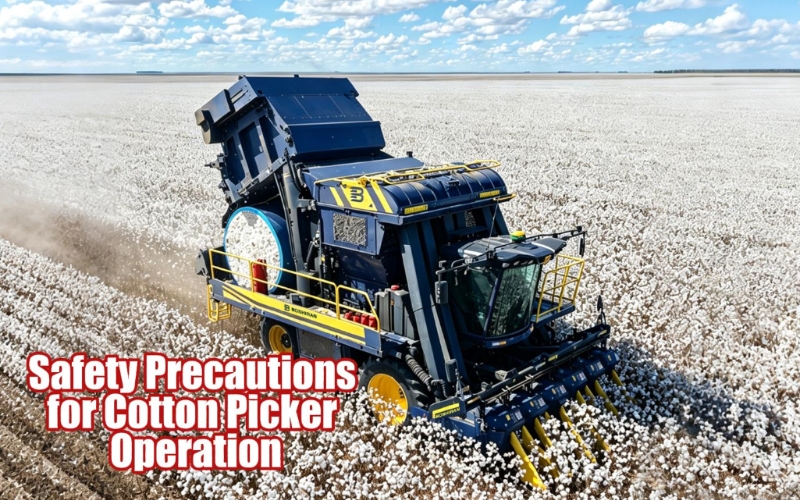
A spindle-type cotton picker works by using rotating spindles to engage seed cotton from open bolls.
As the machine moves through the crop, these spindles repeatedly contact:
cotton fibers;
leaves;
stems;
boll material;
plant sap;
dust and field residue.
Plant material can leave sticky residues on the spindle surface. If this buildup continues, the spindle may gradually lose the clean surface condition needed for consistent cotton pickup and release.
The moistening system helps control this problem.
Its main functions are to:
keep spindle surfaces clean;
reduce plant gum and residue buildup;
support more consistent cotton pickup;
help cotton release from the spindle;
reduce excessive wrapping around the spindle;
maintain more stable picking-unit performance.
The detailed mechanical sequence of spindle picking and doffing is covered separately in Boshiran's guide on how a cotton harvester works.
Although system design varies between cotton picker models, a typical spindle moistening system contains several basic components.
The tank stores the water or approved spindle-cleaning solution used by the system.
Tank capacity determines how long the machine can operate before refilling is required.
The tank should remain clean because sediment or contamination can eventually restrict:
filters;
strainers;
hoses;
nozzles.
The pump moves cleaning solution from the tank through the distribution system.
It must provide sufficient flow for the moistening system to operate consistently across all row units.
If pump output becomes unstable, some sections of the picker may receive less solution than others.
Filters and strainers help prevent debris from reaching small passages and nozzles.
They are especially important because even a small amount of dirt can interfere with solution distribution.
A blocked strainer may cause:
reduced flow;
uneven spindle cleaning;
pressure changes;
dry moistener pads.
Hoses carry the cleaning solution from the tank and pump toward each picking unit.
Before harvest, operators should inspect these lines for:
cracks;
leaks;
kinks;
loose fittings;
damaged connections.
One leaking or restricted hose can affect the performance of an individual row unit.
The solution needs to reach the moistener pads evenly.
Depending on machine design, nozzles or other distribution points control where the liquid enters the moistener assembly.
Blocked nozzles are one of the first areas to inspect when one row appears to have poorer spindle cleaning than the others.
Moistener pads are the components that actually contact or closely interact with the rotating spindles.
They transfer the controlled cleaning solution to the spindle surfaces.
Their condition and position are critical.
Pads that are:
worn;
hardened;
damaged;
poorly positioned;
may not clean the spindles effectively even when the rest of the system is supplying enough solution.
The operating principle is relatively straightforward.
The process begins with an approved cleaning solution in the moistening-system tank.
The exact solution type and concentration should follow the cotton picker manufacturer's instructions.
Operators should not assume that stronger concentration automatically improves cleaning.
During operation, the pump moves solution from the tank into the distribution lines.
The system must provide adequate and consistent flow across the machine.
Before the solution reaches the row units, filters and strainers help remove dirt or sediment.
Clean filtration helps protect the smaller passages downstream.
The solution is distributed to the moistener-pad assemblies through the corresponding hoses and nozzles.
The objective is consistent wetting rather than excessive saturation.
As the spindles rotate through the moistening area, the pads apply cleaning solution to the spindle surfaces.
This helps remove or control sticky plant residue.
The spindle can then return to the picking zone in a cleaner condition.
The process repeats throughout harvesting.
Because every spindle continuously cycles through the picking, doffing, and cleaning areas, the moistening system must work reliably for long periods.
The condition of the spindle surface influences how well the picking system performs.
A clean spindle is better able to interact with exposed cotton.
If residue accumulates, operators may begin seeing:
more cotton left on open bolls;
uneven picking between rows;
cotton wrapping around spindles;
increasing plant residue inside the row unit.
However, spindle cleanliness is only one part of the system.
Similar symptoms may also be caused by:
worn spindles;
worn doffers;
incorrect picker-bar position;
unsuitable ground speed;
poor row-unit alignment.
This is why operators should diagnose the complete picking unit instead of immediately increasing moistening-system flow.
Not necessarily.
The objective is controlled spindle cleaning, not maximum liquid flow.
Too little solution may allow residue to accumulate.
Too much solution may create other problems and unnecessarily increase solution consumption.
Excessive wetting can also make diagnosing picking-unit problems more difficult because operators may attempt to compensate for worn or incorrectly adjusted components by increasing liquid flow.
The correct settings depend on:
cotton picker model;
system design;
crop conditions;
cleaning solution;
manufacturer specifications.
Operators should therefore use the recommended adjustment range rather than trying to maximize solution output.
These two conditions are sometimes confused.
The spindle moistening system applies a small, controlled amount of cleaning solution to the picking components.
Wet cotton occurs when the crop itself contains excessive moisture from:
rain;
heavy dew;
irrigation;
high humidity.
They are not the same.
The moistening system is intended to help the machine function correctly.
Excessive field moisture can make harvesting more difficult by increasing:
cotton and plant-material buildup;
spindle wrapping;
plugging;
conveying problems.
Therefore, operators should not assume that because a cotton picker uses moisture to clean its spindles, harvesting wet cotton is desirable.
Moistening-system problems usually appear as changes in spindle cleanliness or picking performance.
If insufficient cleaning solution reaches the spindles, sticky residue can accumulate.
This may reduce the effectiveness of cotton pickup.
Spindle wrapping can occur when cotton does not release properly.
A poorly functioning moistening system may contribute to this condition.
However, operators should also inspect doffers and spindle condition before assuming moistening is the only cause.
If one row unit receives less solution than the others, its spindles may become dirtier.
This can create noticeable differences in picking quality across the machine.
Uneven flow often points toward:
blocked nozzles;
restricted hoses;
dirty strainers;
worn pads.
A sudden increase in solution usage may indicate:
leaks;
damaged hoses;
incorrect adjustment.
Very low consumption may indicate:
pump problems;
blocked filters;
restricted lines.
Changes in consumption should therefore be investigated rather than ignored.
| Symptom | Possible Cause | What to Check |
|---|---|---|
| Spindles remain dirty | Insufficient solution | Tank, pump, filter, nozzle |
| One row performs poorly | Uneven flow | Hose, nozzle, moistener pad |
| Cotton wraps around spindle | Poor cleaning or doffing | Moistening system, doffer, spindle |
| Pads appear dry | Blocked supply | Strainer, hose, nozzle |
| Excessive solution use | Leak or over-adjustment | Lines, fittings, system setting |
| Uneven pad wetting | Restricted distribution | Nozzles and passages |
| Rapid pad wear | Incorrect contact | Pad position and spindle alignment |
| Residue in tank | Poor system cleaning | Tank and filtration |
This table can help narrow the problem, but the manufacturer's service procedure should always be used for final adjustment.
Moistener pads are wear components and should be checked regularly.
Look for:
torn sections;
missing material;
hardened surfaces;
uneven wear;
excessive deformation;
poor spindle contact.
If one pad is significantly more worn than neighboring pads, investigate why.
Uneven wear can indicate:
incorrect positioning;
misalignment;
abnormal spindle contact.
Simply replacing the pad without correcting the underlying cause may result in the replacement wearing quickly.
There is no single replacement interval that applies to every cotton picker.
Pad life depends on:
annual harvesting area;
spindle condition;
machine adjustment;
crop conditions;
cleaning solution;
maintenance practices.
Replacement should be considered when the pad:
can no longer maintain effective spindle contact;
has significant physical damage;
is excessively hardened;
shows severe uneven wear;
cannot distribute solution effectively.
Condition-based inspection is generally more useful than replacing pads solely because a certain number of operating hours has been reached.
The system should be checked as part of preseason cotton picker maintenance.
Remove sediment, dried residue, and contamination.
Make sure the tank is clean before adding fresh solution.
Clean or replace blocked components.
Do not wait until flow becomes visibly poor during harvesting.
If the machine has been stored for an extended period, check that the lines are free from dried residue or blockage.
Look for:
cracking;
leaks;
loose fittings;
restricted sections.
Do not verify only that the pump works.
Make sure solution reaches each row unit consistently.
Replace pads that are damaged or excessively worn.
Run the system according to the approved procedure and compare distribution across the row units before entering the field.
These steps fit naturally into a complete preseason cotton picker maintenance checklist.
The moistening system should not be inspected only before the season.
During harvest, operators should monitor:
tank level;
solution consumption;
leaks;
spindle cleanliness;
pad condition;
nozzle performance;
differences between row units.
If cotton picker performance changes suddenly, inspect the moistening system early in the troubleshooting process.
A clogged nozzle is much easier to correct than continuing to harvest until excessive buildup causes additional problems.
Ground speed can influence how demanding conditions become for the picking system.
As forward speed increases:
more crop material enters the row units;
spindles encounter plant material more frequently;
cotton flow through the machine increases.
If the moistening system is already performing poorly, symptoms may become more obvious at higher harvesting speeds.
Operators should not use slower ground speed as a permanent substitute for proper spindle cleaning.
Instead, evaluate:
moistening performance;
spindle condition;
doffer condition;
crop conditions;
operating speed.
These variables should work together.
Field conditions can affect spindle contamination and cleaning demand.
Operators may notice different residue levels when:
crop moisture changes;
plants contain more green material;
fields are dusty;
harvesting conditions vary during the day.
However, any adjustment should remain within the manufacturer's recommended operating range.
Avoid repeatedly changing system settings without first identifying the reason for poor picking performance.
The problem may actually be caused by:
worn spindle barbs;
worn doffers;
damaged moistener pads;
blocked airflow;
unsuitable ground speed.
Spindles, doffers, and the moistening system should be viewed as one operating group.
A clean spindle must:
engage cotton;
carry it toward the doffer;
release it effectively;
return through the cleaning area.
If spindle cleaning is poor, cotton release may become less consistent.
If the doffer is worn, increasing cleaning solution will not restore proper doffing.
If the spindle itself is worn, clean surfaces alone cannot restore the original picking capability.
This is why maintenance decisions should not be based on one component in isolation.
When persistent problems occur, inspect the complete picking sequence.
The spindle moistening system on a cotton picker is essentially a controlled spindle-cleaning system.
Its purpose is to apply cleaning solution through moistener pads so rotating spindles remain relatively free from plant gum, dust, and residue during harvesting.
A typical system includes:
solution tank;
pump;
filters and strainers;
hoses;
nozzles or distributors;
moistener pads.
Good moistening-system performance helps maintain spindle cleanliness and supports consistent cotton pickup and release.
Common warning signs of a problem include:
dirty spindles;
cotton wrapping;
uneven row performance;
dry moistener pads;
blocked nozzles;
abnormal solution consumption.
However, the moistening system should always be evaluated together with spindle wear, doffer condition, picker-bar adjustment, crop moisture, and ground speed.
The goal is not to use as much solution as possible. It is to maintain consistent, controlled spindle cleaning according to the requirements of the specific cotton picker model.
Related Products
Discover Our Comprehensive Range of Large Agricultural Machinery Categories