2026-08-20 17:45:11
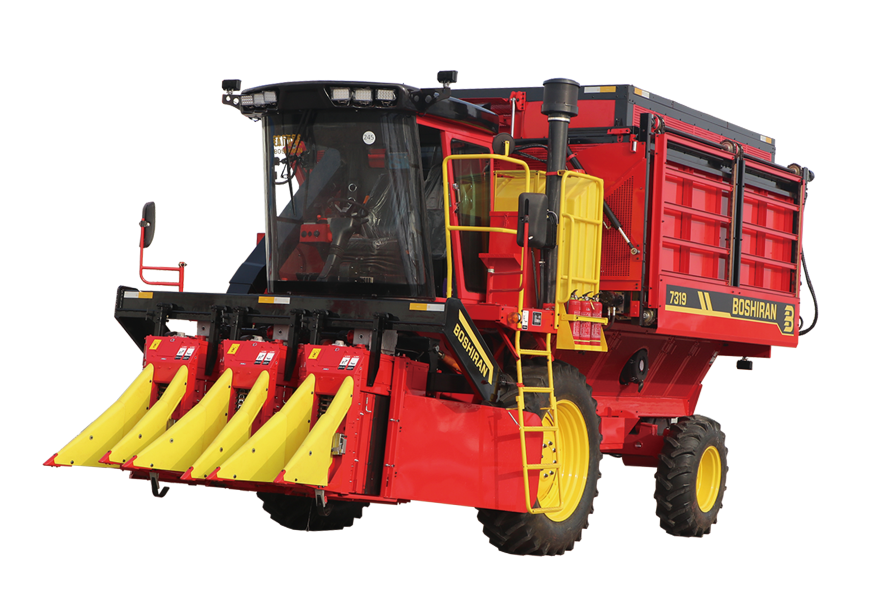
When comparing a cotton picker, the most important specifications are not simply horsepower or the number of rows. Buyers should read the machine as a complete harvesting system: picking rows determine working width, row spacing determines field compatibility, spindle configuration affects the picking system, engine power supports the machine under load, harvesting speed influences productivity, and cotton-handling capacity determines how efficiently harvested cotton moves through the field operation. Boshiran’s current cotton picker range includes different row counts and both basket and baling configurations, illustrating why specifications need to be evaluated together rather than one number at a time.
For buyers comparing machines from different manufacturers, understanding these specifications is often more useful than simply asking which cotton picker has the “largest” numbers.
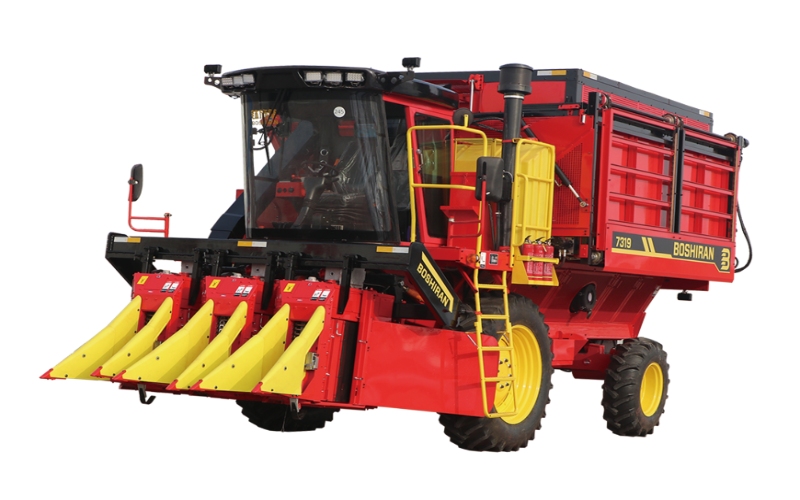
A cotton picker specification sheet may contain dozens of figures:
number of picking rows;
suitable row spacing;
engine power;
spindle quantity;
spindle or drum speed;
harvesting speed;
working productivity;
basket volume;
bale size and weight;
machine dimensions;
operating weight;
fuel capacity.
Each number describes one part of the machine, but none of them independently tells you how well that machine will perform on your farm.
For example, a six-row cotton picker has a wider potential harvesting swath than a three-row machine. But if the field is small, row spacing does not match, turning takes too long, or cotton handling causes frequent interruptions, the larger machine may not achieve its theoretical capacity.
Cotton Incorporated similarly emphasizes that actual harvester productivity depends on factors such as field layout, turning time, unloading, maintenance, operator skill and actual picking time—not working width alone.
That is why cotton picker specifications should answer one main question:
How well does this machine match the way your cotton is planted, harvested and handled?
The number of picking rows indicates how many cotton rows a machine can harvest during one pass.
Common configurations include:
Assuming the same row spacing, a machine with more row units covers a greater working width during each pass.
For example, at a 760 mm row spacing:
3 rows cover approximately 2.28 m of planted row width;
4 rows cover approximately 3.04 m;
6 rows cover approximately 4.56 m.
However, this does not mean a six-row machine automatically harvests twice as many hectares per hour as a three-row machine.
Real field productivity is affected by:
operating speed;
turning time;
field length;
unloading or baling time;
crop yield;
maintenance interruptions;
operator efficiency;
terrain and field condition.
Boshiran’s existing 3-Row vs 4-Row vs 6-Row Cotton Picker comparison explains the machine-selection side of this topic in greater detail.
For a specification sheet, the important point is simpler:
Row number tells you potential working width—not guaranteed harvesting capacity.
Before comparing horsepower, speed or basket capacity, buyers should confirm cotton row spacing.
Row spacing is the distance between neighboring planted cotton rows. The picker row units must correspond properly with the planting pattern.
Common cotton production systems may use row spacings such as:
760 mm / 76 cm;
900 mm / 90 cm;
approximately 30 inches;
approximately 36 inches;
approximately 38–40 inches.
Cotton Incorporated notes that traditional cotton systems were commonly based around 38- to 40-inch rows, while modern row-unit designs can accommodate considerably narrower configurations in some harvesting systems.
This specification matters because incorrect matching between the planter pattern and cotton picker row units can increase harvesting losses.
Cotton Incorporated specifically warns that picker row-unit spacing should match the planter spacing and planting pattern; otherwise, rows may progressively fall out of alignment during harvesting.
Correct row compatibility helps the picker:
keep each plant properly centered in the row unit;
maintain more consistent contact between plants and picking components;
reduce unnecessary plant disturbance;
avoid excessive stalk and ground loss;
maintain smoother forward movement.
Boshiran models also illustrate that row-spacing compatibility differs by machine. For example, its 3-row basket picker is specified for 76 cm planting configurations, while some other machines in the range are designed around 760 mm and 900 mm arrangements.
So when requesting a cotton picker quotation, buyers should provide their actual planting row spacing, not just annual acreage.
The spindle is one of the defining components of a spindle-type cotton picker.
Spindles rotate within the picking unit and interact with exposed seed cotton. The detailed mechanical process is covered separately in How Does a Cotton Harvester Work?, so the important issue here is how to interpret spindle-related specifications rather than repeat the picking process.
A cotton picker specification sheet may list:
number of picking heads;
number of drums;
spindle bars per drum;
spindles per bar;
spindles per picking head;
total spindle quantity;
spindle rotation speed.
These figures describe the architecture of the picking system.
For example, Boshiran’s three-row basket machine lists 1,512 total spindles, while its six-row baling cotton picker lists 3,024 spindles.
But buyers should be careful with a common assumption:
More spindles do not automatically mean a better cotton picker.
Spindle count must be considered together with:
number of rows;
drum arrangement;
picking-head design;
spindle condition;
rotation and synchronization;
row-unit adjustment;
crop maturity.
Cotton Incorporated notes that spindle-picker performance can deteriorate when spindles are worn or when the picker is incorrectly adjusted. Even a well-designed picking system cannot maintain good field performance if components are poorly maintained.
Therefore, spindle specifications help describe the picking capacity and architecture of the machine, but maintenance accessibility and replacement-part availability are equally important purchasing considerations.
Cotton pickers require substantial power because one engine may simultaneously support:
vehicle propulsion;
picking units;
hydraulic systems;
fans and pneumatic conveying;
cotton basket operation;
onboard compaction or baling systems;
cooling and auxiliary systems.
This is why larger and more integrated cotton pickers generally require greater engine power.
For example, Boshiran currently lists approximately 260 kW for its 3-row basket cotton picker and substantially higher power for its larger 6-row cotton picker with onboard baling.
However, buyers should not compare two cotton pickers by horsepower alone.
Higher power may be required because a machine is:
heavier;
wider;
driving more picking rows;
operating a larger fan system;
using four-wheel drive;
powering a baling system.
In other words:
Engine power is the machine's available power supply, not a direct measure of how many hectares it will harvest per hour.
A better comparison is whether the engine has sufficient reserve for the machine's total working load without unnecessarily increasing fuel consumption or machine complexity.
Cotton picker specification sheets often contain several speed figures, and this can easily cause confusion.
They may include:
harvesting speed;
first-gear picking speed;
second-gear picking speed;
maximum field speed;
road or transport speed.
These numbers are not interchangeable.
A machine capable of traveling at 23 km/h on the road obviously does not harvest cotton at 23 km/h.
For example, Boshiran’s 3-row basket model lists field gear ranges up to approximately 6.2 and 7.6 km/h, while its road travel speed reaches 23 km/h.
Actual picking speed depends on:
cotton yield;
boll opening;
plant height;
field smoothness;
terrain;
row alignment;
operator visibility;
picking-head adjustment.
Cotton Incorporated points out that field and crop conditions can require changes to row-unit position and operating speed, while improper synchronization between ground travel and the picking system can affect cotton quality, wear and machine performance.
Therefore, buyers should interpret a specification such as “0–6.8 km/h harvesting speed” as an operating range, not a guarantee that the machine should always harvest at its maximum stated speed.
The word capacity is especially easy to misunderstand because it can describe several different things.
A cotton picker can have:
field capacity;
cotton storage capacity;
bale capacity;
hourly productivity.
These should be evaluated separately.
Field capacity refers to how much land the picker can effectively harvest within a given period.
It is influenced by:
working width × harvesting speed × field efficiency
Field efficiency accounts for time that is not spent actively harvesting, including:
turning;
unloading;
adjustments;
waiting;
maintenance;
field obstacles.
This is why actual productivity is always lower than a theoretical calculation based only on width and speed.
Cotton Incorporated's harvesting studies show meaningful differences between theoretical operating capability and actual field capacity depending on harvesting and cotton-handling systems.
For a conventional basket cotton picker, the specification may be given in cubic meters.
For example, Boshiran's 3-row and 4-row basket machines list cotton-bin or basket volumes around 28 m³.
A larger basket can allow more cotton to be collected before unloading, but it also adds weight and does not eliminate the need to consider unloading logistics.
Cotton Incorporated notes that conventional basket systems depend on coordinated unloading and supporting equipment, and under well-managed conditions a basket picker may spend around 70% of operational time actively picking.
A baling cotton picker should instead be evaluated using specifications such as:
bale diameter;
bale width;
bale weight;
chamber size;
automatic or manual packing range.
For example, Boshiran's 4-row baling model lists a bale-weight range of approximately 800–1,800 kg, while its 3-row baler lists approximately 800–1,200 kg.
These specifications relate primarily to cotton handling after picking, rather than the picking mechanism itself.
That distinction is important when comparing basket and baling cotton pickers.
Dimensions may look like secondary specifications, but they can affect whether a cotton picker is practical for a particular farm.
Check both:
working dimensions;
transport dimensions.
A large six-row cotton picker may offer strong field productivity, but its width, height and length also affect:
road transport;
farm entrances;
bridges;
storage buildings;
turning areas;
shipping arrangements.
Machine weight is equally important.
Heavier machines may require additional attention to:
soil bearing capacity;
compaction;
field access;
tire configuration;
transport regulations.
For example, Boshiran's current published specifications range from approximately 13.2 tonnes for a 3-row basket machine to around 32 tonnes for a 6-row baling machine, illustrating how significantly machine scale changes across product categories.
For international buyers, transport dimensions should therefore be reviewed before purchase—not after the machine has been ordered.
Rows, spindles, power and speed receive most of the attention, but several secondary specifications can make a major difference during a harvest season.
This indicates how low the machine can effectively access cotton bolls.
Boll position varies with variety, planting conditions and crop development, so this specification can matter in crops where fruiting starts relatively close to the ground.
A larger fuel tank can reduce refueling interruptions, particularly when harvesting large fields far from service facilities.
However, tank size should be considered together with actual fuel consumption.
Spindle picker systems require proper spindle cleaning and moistening. Cotton Incorporated notes that inadequate moistening and plant buildup can contribute to reduced picking efficiency.
Tank capacity therefore influences how long the machine can operate between service stops.
Turning radius becomes especially important in:
short fields;
fragmented farms;
narrow headlands;
irregular field layouts.
A machine with impressive straight-line capacity may lose much of that advantage if considerable time is spent turning.
| Specification | What It Tells You | What Buyers Should Check |
|---|---|---|
| Number of rows | Potential harvesting width | Farm size, field layout, harvest window |
| Row spacing | Planting compatibility | Actual planted row configuration |
| Spindle quantity | Picking-system architecture | Rows, drums, maintenance, spare parts |
| Engine power | Available operating power | Machine size and system load |
| Harvesting speed | Possible field operating range | Crop and field conditions |
| Field productivity | Actual area harvested over time | Field efficiency and downtime |
| Basket volume | Seed cotton storage before unloading | Unloading frequency and support equipment |
| Bale size/weight | Onboard cotton-handling capacity | Transport and downstream handling |
| Machine weight | Overall equipment scale | Soil, transport and field access |
| Dimensions | Working and transport envelope | Roads, storage, turning and shipping |
When comparing cotton picker models, use the specifications in the following order.
First, confirm field compatibility.
Check row spacing, number of rows, field dimensions and turning space.
Second, evaluate the picking system.
Look at picking heads, drums, spindles and maintenance requirements.
Third, examine power and operating speed.
Determine whether the drivetrain can support the machine's complete harvesting system under your expected field conditions.
Fourth, evaluate real capacity.
Do not look only at maximum speed. Consider effective field productivity, unloading or baling interruptions and available harvest hours.
Finally, review logistics.
Machine dimensions, weight, fuel capacity, cotton storage, spare parts and service support can significantly affect the real cost of harvesting.
The key principle is simple:
The best cotton picker specification is not the biggest number on the brochure. It is the combination of specifications that best matches your planting pattern, field conditions, harvest volume and cotton-handling system.
For buyers comparing Boshiran machines, the published product specifications can be used to narrow the initial selection, while row spacing, acreage, field layout and preferred basket or baling configuration should be confirmed before choosing a final model.
Related Products
Discover Our Comprehensive Range of Large Agricultural Machinery Categories